








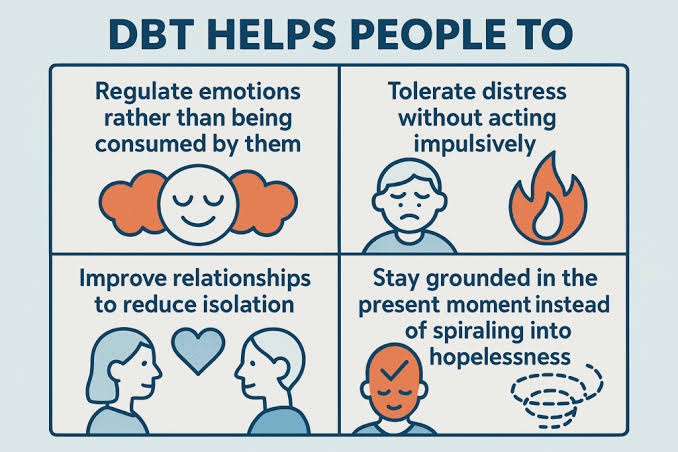
DBT skills groups build emotional regulation in adults by teaching concrete, repeatable techniques for noticing emotions, reducing their intensity, and responding to them without acting on impulse. The group format adds structure, practice, and accountability that help skills carry over into daily life.
DBT was originally developed to treat borderline personality disorder and has since been adapted for other conditions (National Institute of Mental Health).
What is dialectical behavior therapy?
Dialectical behavior therapy is an evidence-based form of cognitive behavioral therapy that balances acceptance and change. It was originally developed for people with intense emotional dysregulation and is now used across a wide range of conditions. DBT focuses on helping people manage painful emotions and reduce conflict in relationships (National Institute of Mental Health).
Conditions commonly treated with DBT
- Borderline personality disorder
- Depression with emotional volatility
- Anxiety and panic
- Post-traumatic stress symptoms
- Substance use disorders
- Self-harming behaviors
Who leads DBT skills groups
DBT skills groups are typically led by clinicians with specific DBT training, and one virtual IOP serving Missouri and Illinois assigns a DBT-certified licensed professional counselor to lead its group therapy (Lakeside Behavioral Health).
What are the 4 core DBT skill modules?
The 4 core DBT skill modules are mindfulness, distress tolerance, emotion regulation, and interpersonal effectiveness. Skills groups typically rotate through all 4 modules over a set number of weeks.
Mindfulness
Mindfulness teaches participants to observe thoughts and emotions without judgment. It is the foundation for every other module because skills require awareness before they can be applied.
Distress tolerance
Distress tolerance teaches participants to survive intense moments without making them worse. Skills focus on short-term crisis survival rather than solving the underlying problem.
Emotion regulation
Emotion regulation teaches participants to identify emotions, understand their function, and reduce vulnerability to overwhelming emotional states.
Interpersonal effectiveness
Interpersonal effectiveness teaches participants to ask for what they need, say no, and maintain relationships and self-respect during conflict.
How does emotion regulation training work?
Emotion regulation training works by breaking emotions into identifiable parts, then teaching specific actions that change their course. Participants learn that emotions follow patterns and that those patterns can be interrupted.
Emotion regulation skills taught in groups
- Naming emotions precisely rather than saying “bad” or “stressed”
- Checking the facts to see whether the emotion fits the situation
- Acting opposite to the emotion’s urge when the urge is unhelpful
- Building positive experiences into each week
- Reducing vulnerability through sleep, nutrition, and exercise
Opposite action is one of the most practical skills. A person who feels the urge to withdraw when sad might instead call a friend or take a walk, which can shift the emotional state.
Why does the group format help skill-building?
The group format helps skill-building because participants learn from each other’s examples, practice skills in real time, and receive feedback from both facilitators and peers. Skills taught in a classroom structure are easier to remember than skills mentioned once in individual therapy.
Advantages of group-based DBT
- Structured curriculum with clear weekly goals
- Homework review that reinforces practice
- Peer modeling of skill use
- Reduced isolation and shame
- Cost-effective delivery compared with individual sessions alone
Groups typically meet weekly for 90 minutes to 2 hours in standard DBT, and more frequently inside intensive outpatient programs.
What happens in a typical DBT skills group session?
A typical DBT skills group session begins with a brief mindfulness exercise, moves into homework review, and ends with instruction on a new skill. Facilitators follow a structured manual.
Session structure
- Opening mindfulness practice
- Review of skill practice from the prior week
- Teaching of a new skill with examples
- Practice or role-play during group
- Assignment of homework for the coming week
Participants use diary cards to track emotions, urges, and skill use between sessions. The diary card gives the group concrete data to discuss.
Where are DBT skills groups offered?
DBT skills groups are offered in outpatient clinics, intensive outpatient programs, partial hospitalization programs, and increasingly through secure telehealth. Virtual delivery expands access for adults who cannot travel to a clinic several times per week.
Who benefits most from DBT skills groups?
Adults who experience intense emotions, impulsive reactions, or recurring relationship conflict benefit most from DBT skills groups. Participants do not need a specific diagnosis to gain value from the skills. Signs that DBT skills training may help include frequent emotional overwhelm, difficulty calming down after arguments, reliance on substances or avoidance to cope, and a pattern of regretting reactions after the moment passes.
How do DBT skills support people with trauma histories?
DBT skills support people with trauma histories by building stability before trauma-focused work begins. Distress tolerance and emotion regulation give patients tools to manage flashbacks, emotional flooding, and urges to avoid or numb.
Why skills come before trauma work
Coping skills for managing strong emotions are a useful part of recovery for trauma survivors (VA National Center for PTSD). Clinicians often teach DBT skills first, then introduce trauma-focused therapy once a patient can tolerate distress safely. That sequence lowers the risk of dropout during difficult phases of treatment and helps patients stay engaged through the full course of care.
How long does it take to see results?
Results from DBT skills groups typically become noticeable within 4 to 8 weeks of consistent attendance and practice, with deeper change developing over several months. A full rotation of all 4 modules in standard DBT often lasts about 6 months.
What speeds progress in DBT
Participants who practice skills daily, complete diary cards, and bring real situations to group tend to make the fastest progress. DBT skills are learned behaviors, and like any skill, they strengthen with repetition.